
The short answer
- • Anil Singhvi has been Managing Editor of Zee Business since 2 April 2018. Before that he spent about 13 years at CNBC Awaaz, latterly as Executive Editor.
- • He is a Chartered Accountant and a Company Secretary, both qualified in 1993 — which makes him one of very few Indian market anchors who trained in the numbers before he trained in the camera.
- • He fronts roughly four hours of live television every trading day, across at least nine distinct formats — and those formats commit to very different things. A "Stock of the Day" pick is not the same animal as an "Editor's Take" view.
- • Every trading call he issues is packaged with a target and a stop-loss. That packaging is the single most consistent thing about his output.
- • He is not named in any SEBI order relating to the Zee Business guest-expert front-running case.
- • He has repeatedly warned that fake Telegram and YouTube channels trade on his name. Neither he nor Zee Business runs one.
Kaun hain Anil Singhvi? The 60-second version
If you have watched Hindi business television at any point in the last twenty years, you have watched Anil Singhvi. He is the Managing Editor of Zee Business, the channel's most visible face, and the person whose name Zee Business itself attaches to more segments than anyone else's.
The bones of the record, and these are solid:
He qualified as a Chartered Accountant in 1993, and as a Company Secretary the same year. In 1992–93 he was Secretary of WICASA, the Western India Chartered Accountants Students' Association. He is from Rajasthan — Chittorgarh, according to the Hindi trade press, where he is also reported to have gone to a Hindi-medium government school. His birthday is 2 June.
He joined Zee Business as Managing Editor on 2 April 2018, a move announced by the trade press on 3 April. At the time he reported to then Editor-in-Chief Sudhir Chaudhary, and every channel team reported into him. Before Zee, he spent about 13 years at CNBC Awaaz, ending as Executive Editor.
One detail worth having, because it anchors his age better than any of the gossip sites: Zee Media Corporation Ltd's own annual reports list his age in the statutory employee-particulars table. FY2020-21 lists him at 51; FY2023-24 at 54. Those reports also list his total professional experience at 28 years in FY21, rising to 31 by FY24 — which puts the start of his working life at 1993, exactly where the CA and CS qualifications sit.

The twelve missing years
Here is something nobody writes, so we will.
Between qualifying as a CA and CS in 1993 and his first documented television role around late 2005, there are roughly twelve years that are not in the public record anywhere we could find. Not on his LinkedIn, not in the trade-press announcements, not in Zee Media's filings, not in a single interview we could locate.
The content farms fill that gap confidently — Ambit Capital, Reliance Capital, Reliance Money, a stint at ICAI. Those are all the wrong man. There is a second, equally prominent Anil Singhvi in Indian finance: born 1959 in Jodhpur, former MD and CEO of Gujarat Ambuja Cements, founder of the proxy-advisory firm IiAS, and a director on several listed boards. The two get conflated constantly. If you read that "Anil Singhvi ran Gujarat Ambuja before joining Zee Business," you are reading two biographies stitched together.
So: twelve years, undocumented. That is not sinister — most people's early careers aren't on the internet. It's just honest to say we don't know rather than to invent it.
Why he chose Hindi, and why it worked
Zee Business's own trade-press coverage reports that CNBC Awaaz picked him up at 35, and that he arrived without a journalism background. What he did next is the interesting part.
Rather than imitating the register of English business channels — measured, analyst-ish, faintly institutional — he went the other way. "I decided to make Hindi my strength," he has said, and the on-air result is a deliberately un-anchorly voice: conversational, blunt, closer to how a person actually talks about money than to how a research report reads.
It is also why his segment names read the way they do. 10 Ki Kamai. Bazaar Aaj Aur Kal. Nivesh Ki Paathshala. Nobody translates those into English, because the Hindi is the product.
That choice is worth flagging for a specific reason. A lot of what Indian retail investors get from television is not analysis — it is vocabulary. The reason a retail trader in a tier-3 town knows the phrase "stop-loss" at all is largely that Hindi business TV repeats it every twenty minutes. On Hindi Diwas in September 2022, Singhvi tweeted a question to his audience: "स्टॉपलॉस को हिंदी में क्या कहते है?" — what do we call stop-loss in Hindi? It reads like a joke, and it is, but it's also a fair summary of what the last decade of Hindi business television has actually done to the language of Indian retail investing.
His day: roughly four hours of live television
This is the part most profiles skip, and it's the part that explains everything else.

The pattern is clear even if the exact clock times drift. He owns the open, the close, and the wrap-up. The middle of the trading day — the commodity slots, the F&O segments, the midcap hour, the viewer-question shows — belongs to other anchors and to guest experts.
That structure matters when you are judging a call, because the calls that come out of the open and the calls that come out of the close are answering completely different questions. The 8 AM call is a plan. The 3 PM call is a verdict.
One timing we can state with confidence, because Zee Business announced it themselves: Bazaar Aaj Aur Kal launched on 18 November 2019 and runs Monday to Friday at 7:26 PM, twenty-two minutes long, with a repeat at 9:26 PM. Singhvi's stated rationale at launch was that viewers are busy through the day and need the market compressed into one segment after it. "With dynamic changes in the market, it is critical for an investor to constantly stay tuned to what is happening," he said.
The nine formats — and what each one actually commits to
Here is the table we wish existed when we started tracking his signals. Different formats, very different commitments.
| Format | What it is | Does it name a stock? | Target? | Stop-loss? | Horizon |
|---|---|---|---|---|---|
| Editor's Take | His own market view — direction, triggers, what traders vs. investors should do | Sometimes | Index levels, not always stock targets | Rarely | Same day to a few weeks |
| Stock of the Day | Named daily picks | Yes | Yes | Yes | Intraday to short positional |
| Anil Singhvi's Market Strategy | Nifty and Bank Nifty levels, where to buy, where to book | Index-level | Levels | Levels | Session |
| Share Bazaar Live / First Trade | Pre-open and opening hour, live calls | Yes | Yes | Yes | Intraday |
| 10 Ki Kamai | Mid-morning picks, often with guest experts | Yes | Yes | Yes | Intraday |
| Final Trade | Closing block, closing calls and next-day setup | Yes | Yes | Yes | Overnight to short |
| Bazaar Aaj Aur Kal | Post-close wrap and tomorrow's setup | Yes | Yes | Yes | Next session |
| SIP Stock with Anil Singhvi | Long-term accumulation idea with a numbered list of triggers | Yes | 12–18 month target | No | Long |
| IPO Review | Binary verdict on a public issue | The issue | No | No | Listing / long term |
A worked example of the SIP Stock format, because it is the most structured thing he does. On a Welspun Enterprises recommendation, Zee Business published six stated triggers: a ₹5,500 crore order book, an asset-light model, a cash-rich balance sheet, an Adani joint venture, promoter stake rising from 47.3% to 50.25%, and a 12–18 month target of ₹200–225. Whatever you think of the call, that is a legible thesis with a horizon attached. It is a very different object from a 9:40 AM intraday buy.
The IPO Reviews are the other end of the spectrum: a binary Subscribe or Avoid, sometimes with a "avoid now, consider post-listing" variant. On the JSW Cement IPO in August 2025, for instance, the verdict was Avoid.
Why this matters: if you are scoring his calls — which is what this site does — you have to score each format against its own promise. Marking a 12–18 month SIP Stock idea as a "miss" after three weeks isn't a scorecard, it's a category error.
The one habit that runs through everything: the stop-loss
Look at how Zee Business writes its own headlines and the pattern is impossible to miss:
"अनिल सिंघवी ने आज कमाई के लिए चुने ये 2 Stocks… नोट कर लें टारगेट डीटेल"
"TGT-स्टॉपलॉस समेत पूरी डीटेल"
Target aur stop-loss, har baar. The number is packaged into the call itself, not left to the viewer.
We will be honest about the limits of what we can say here. We could not find a documented, quotable catchphrase of his about stop-losses — plenty of sites put one in quotation marks, none of them source it. What we can say, because it is visible in hundreds of published segments, is that the format itself enforces it. A call without a stop-loss doesn't make it to air in his blocks.
That is not nothing. As we've argued elsewhere, the stop-loss is the only one of the three numbers that actually protects you — the entry is the least important, and it is the one that has usually already moved by the time you hear it.
What he does not do
Equally useful, and equally unwritten.
He does not appear to have a documented public stance on retail F&O. He gives futures calls; we found no statement for or against retail participation in derivatives. If you read otherwise, ask for the source.
He does not appear to have a documented stance on IPO grey market premium. His IPO reviews are framed on valuation and business quality, not GMP.
He is, as far as any public record shows, not a SEBI-registered Research Analyst — and under SEBI's own rules he probably doesn't need to be. SEBI's FAQ on the Research Analyst Regulations states that a person who makes recommendations "only through public media" is not required to register. But — and this is the part almost nobody writes — the exemption is conditional. Regulations 16 and 17 still apply, which means disclosure of any financial interest in the subject company, and a trading restriction: no trading in that security for 30 days before and 5 days after expressing the opinion. We'll unpack that in a separate piece, because it is more consequential than it sounds.
The awards, and what they do and don't tell you
At the 17th ENBA Awards in late 2025, Zee Business won eleven. Singhvi personally took Gold for Best Business Channel Anchor (Hindi), Silver for Most Influential News Personality, and Silver for Best Business and Finance Journalist, plus Editor of the Year. Share Bazaar Live and First Trade took Gold as a paired block; News Par Views, his long-form CEO interview show, took Gold for Best Business Channel Talk Show.
Further back: he received the President's Scout Award from President R. Venkataraman in 1987, and was honoured by Rajashree Birla in 2011 for contribution to business journalism.
One award we want to explicitly knock down, because it is on a page that currently ranks: there is no evidence he has received a Ramnath Goenka Award. That claim sits on a site that also calls him "Chairman," dates his Zee joining to 2007, and lists shows that do not exist. Treat that page as fiction.
What awards tell you is that the industry rates the broadcasting. What they do not tell you is anything about whether the calls made money. Those are separate questions, and only one of them can be measured.
The scale question: 77.4% or 47.6%?
Zee Business publicises its BARC numbers energetically, and you will see the figure 77.4% viewership share repeated a lot. It is real — for Week 41 of 2024, on a specific target group and daypart. In November 2024 the channel rang the bell at BSE to mark it, with Singhvi leading a special broadcast from 8 AM on 5 November.
Here is the same year, a different week:
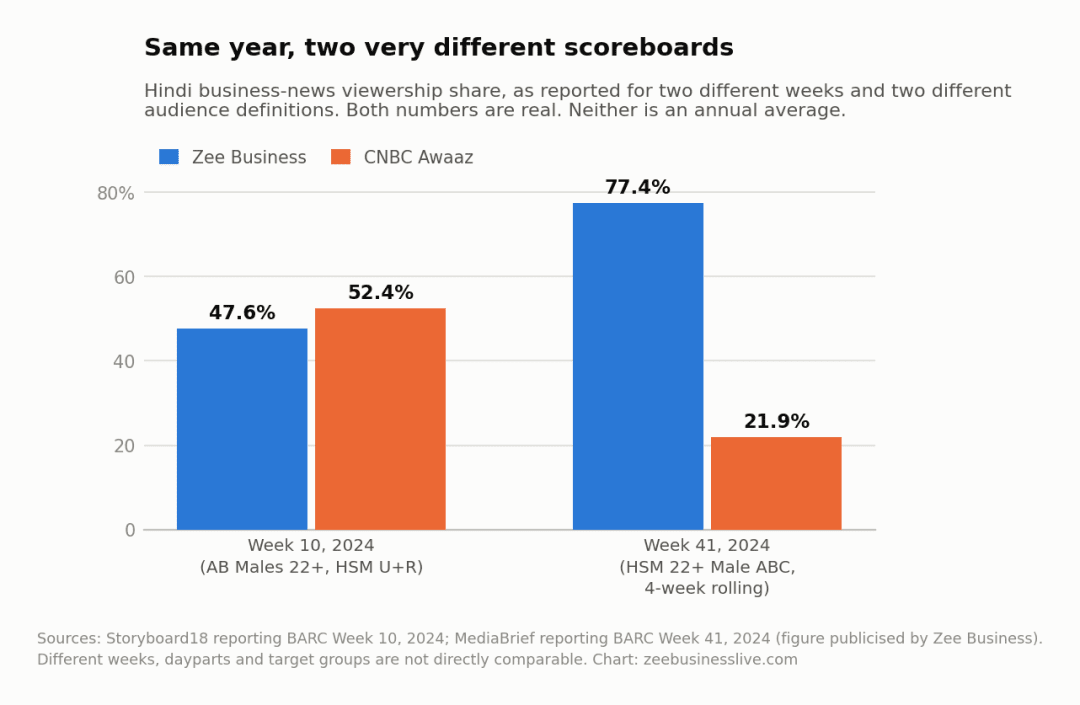
Different weeks, different audience definitions, different stories. Weekly BARC share is a real number and a bad summary statistic. We include it because you will encounter it, not because it settles anything.
The impersonation problem — and this one is worth reading twice
Since at least January 2022, Singhvi and Zee Business have repeatedly and publicly warned that fake accounts trade on his name. His statement then was unambiguous:
"There is no personal channel of Zee Business or any of its employee including 'me' on Telegram, or any other messaging platform."
In Hindi, the same week: "सावधान, मेरा और हमारे किसी भी एंकर का टेलीग्राम पर कोई चैनल नही हैं।"
He has issued further alerts since about fake videos and fabricated messages attributed to him online. If a Telegram group, a WhatsApp broadcast, or a YouTube channel is offering you "Anil Singhvi ke calls" — paid or free — it is not him. Yeh seedhi baat hai. Har baar check kariye.
The SEBI case, and exactly where he sits in it
We have to address this, because "Zee Business" and "SEBI" appear in the same sentence a lot, and the distinction matters.
In February 2024, SEBI passed an interim order in the matter of "trading based on the stock recommendations given by Guest Experts appearing on Zee Business Channel." Five guest experts were named, each with their own branded segment. The mechanism was front-running: recommendations were passed to traders via messaging apps before broadcast, and those traders bought options in the recommended names minutes ahead of air. Unlawful gains of ₹7.41 crore were disgorged. A settlement order followed in January 2025, and in July 2025 SEBI imposed ₹4 crore in penalties and debarred four entities.
Anil Singhvi is named nowhere in any of those orders. Zee Media's public position, stated in November 2024, was that it "had no involvement in the trading activities of external and independent guests," that it had cooperated fully, and that SEBI's direction to the company was limited to preserving records.
That is the whole of what can be said accurately, and we'd rather say exactly that than either less or more. We'll cover the case itself in detail separately — it deserves its own piece, because its central premise is that the timestamp of an on-air recommendation is material market information. Which is, as it happens, the premise this entire site is built on.
So how should you actually read an Anil Singhvi call?
Four things, in order:
- Identify the format first. Stock of the Day and SIP Stock are not the same product. Check the horizon before you check the price.
- Check the stop-loss against the current price, not the quoted price. If the stock has already run past the entry, the trade's risk-reward has changed even though nothing about the reasoning has.
- Note the time. Not approximately — exactly. A call is a claim made at a moment, and a claim made at 9:42 AM is a different claim by 10:05.
- Score the format against its own promise. Then keep score. Consistently, over months, with the sample size written down.
That last one is the whole reason this site exists. We are not in the business of telling you whether to follow television calls. We are in the business of writing down what was said, when it was said, and what happened next — so that the question stops being a matter of opinion.
Frequently asked questions
Who is Anil Singhvi?
Anil Singhvi is the Managing Editor of Zee Business, a Hindi business news channel. He has held the role since 2 April 2018. He is a Chartered Accountant and Company Secretary who qualified in 1993, and spent roughly 13 years at CNBC Awaaz before joining Zee Business.
Which shows does Anil Singhvi anchor on Zee Business?
He fronts or is the named voice of Editor's Take, Share Bazaar Live, First Trade, 10 Ki Kamai, Final Trade, Bazaar Aaj Aur Kal, Bazaar Agle Hafte, News Par Views, Stock of the Day, SIP Stock with Anil Singhvi, IPO Review and Anil Singhvi's Market Strategy. He does not anchor Money Guru, which is Swati Raina's show.
Is Anil Singhvi SEBI registered?
There is no public evidence that he holds a SEBI Research Analyst registration. Under SEBI's own FAQ on the Research Analyst Regulations, a person who makes recommendations only through public media is not required to register — though the disclosure obligations under Regulations 16 and 17, including a 30-day-before and 5-day-after trading restriction, still apply.
Was Anil Singhvi involved in the Zee Business SEBI case?
No. He is not named in any of SEBI's orders in the matter of trading based on recommendations given by guest experts on Zee Business. Those orders name five guest experts and ten associated entities. Zee Media stated it had no involvement in the guests' trading.
Does Anil Singhvi have a Telegram channel?
No. He and Zee Business have publicly and repeatedly stated that neither he nor any Zee Business anchor operates a Telegram channel, and have warned viewers about fake accounts and fabricated videos using his name.
How old is Anil Singhvi?
Zee Media Corporation Ltd's annual reports list his age as 51 in the FY2020-21 employee-particulars table and 54 in FY2023-24, which puts his birth year around 1970. His birthday is 2 June. We have not found a primary source confirming the year outright, so treat it as an inference rather than a fact.
What is Anil Singhvi's net worth?
It has never been disclosed and is not publicly verifiable. The only documented financial figure is his remuneration from Zee Media Corporation Ltd, which the company's annual reports put at roughly ₹1.0–1.3 crore a year between FY2021 and FY2024. We went through the filings line by line in a separate piece.
Related reading
- How to Read Zee Business Trade Signals (Without Getting Burned)
- Anil Singhvi Net Worth: What the Filings Actually Say
- Browse every signal in the database · Performance analytics
Disclaimer: ZeeBusinessLive is an independent record of stock signals broadcast on television. It is not affiliated with, endorsed by, or sponsored by Zee Business or Zee Media Corporation Ltd. Nothing here is investment advice. Data is captured automatically and may contain errors. Consult a SEBI-registered adviser before acting on any signal.
Sources: Adgully and Exchange4media (3 April 2018); Exchange4media (3 June 2025); Zee Media Corporation Ltd Annual Reports FY2020-21 to FY2024-25; Zee News and Exchange4media on the launch of Bazaar Aaj Aur Kal (November 2019); Zee Business on the 17th ENBA Awards; Zee Business, "Fake social media accounts busted" (13 January 2022); Samachar4Media (14 January 2022); SEBI settlement order dated 16 January 2025 and Business Standard (28 July 2025); Investing.com on Zee Media's statement (2 November 2024); SEBI FAQs on the Research Analyst Regulations; Storyboard18 and MediaBrief on BARC data (2024).